© Written by Keith Layman, Hamilton Ridge Damara Stud, NSW, Australia
Based on the knowledge and firsthand experience of Danie Jansen van Vuuren, Weerlig Damara Stud, Namibia
Introduction
This is the story of an uncle and nephew, Toy Maritz and Daan van Vuuren — one who risked everything to move purebred Kaokoland sheep across one of the most heavily policed boundaries in southern African history, and one who grew up in the shadow of that risk and spent his entire life turning it into something permanent — and how their decisions in 1940s Namibia helped shape the Damara breed we know today, in Namibia, in South Africa, in Australia, and everywhere else it’s now found.
In April 1954, on a farm in Namibia’s remote northwest, government officials confiscated around fifty sheep from two farmers who’d spent the better part of a decade breaking the law to bring them there.
It could easily have been the end of the story. Instead, it was the beginning of the modern Damara breed.
It’s a story of a veterinary cordon fence that cut a country in half, a research station that unknowingly became the breed’s cradle, a world record ram, and a family bloodline that runs unbroken from 1940s Kaokoland to a Windhoek show ring in 2025.
This story comes to us directly from Danie Jansen van Vuuren, Daan’s son, who still breeds his father’s sheep today at Weerlig — and who generously shared his family’s history, and his father’s own photographs, to help us tell it properly.
PART 1 — THE LINE ON THE MAP
To understand the Damara breed, you must understand what these sheep endured long before they ever reached Australia. The story begins on a single farm in Namibia’s remote northwest, decades before anyone thought to call these animals a breed at all.
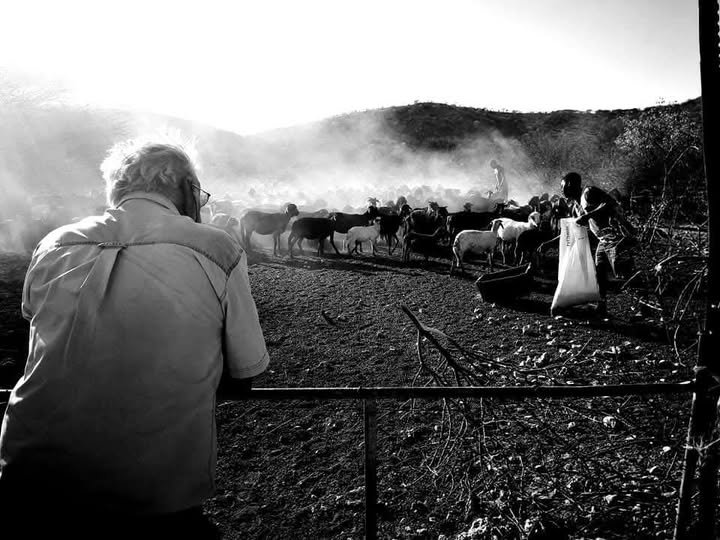
Born in Outjo on 1 November 1944, Daantjie Jansen van Vuuren was raised on Weerlig Farm in northwestern Namibia, where mopane woodland gives way to rugged granite outcrops and vast open rangelands, and where his family had already established themselves as farmers. He would go on to farm there for the rest of his life, until his death in September 2019, at almost 75.
Weerlig is Afrikaans for lightning — an apt name, because the granite outcrops on the farm seem to catch fire from within whenever a storm rolls through, flickering silver-white with every strike, as though the rock itself were reaching up to pull the lightning down from the sky. Fittingly, Van Vuuren is a Dutch surname that translates roughly as “of fire.” There was lightning in the family name long before there was a nickname to match it — and Daan leaned into it himself, fond of introducing himself over a drink as “Daan van die Weerligte,” Daan of the Lightnings.
Locally, Daan was known simply as Weerlig — a nickname that fit a man who was, by every account, larger than life: a champion Damara breeder, a talented performer who once shared a stage with well-known Afrikaans entertainers Tolla van der Merwe and Jan Spies, a self-taught musician who played a tea-chest bass he’d built himself, and a founder of an environmental trust that still cleans up Namibia’s Torra Bay coastline today.
But the man the world came to know as Weerlig inherited a story that began before he was even born, when he was still too young to understand what his family was risking. That story starts with his uncle, Toy Maritz — his mother’s brother — and Maritz’s father-in-law, Piet Grové, who together brought the first Damara sheep out of Kaokoland.
At the time, this was South West Africa, administered by South Africa under a League of Nations mandate — the same territory that would become the independent nation of Namibia in 1990. In the 1940s and 50s, South West Africa was divided by a line on the map that everyone in the territory simply called the Red Line — a 1,250-kilometre veterinary cordon fence dividing the communal north, where Himba and Herero herders kept their stock, from the Police Zone in the south, where commercial farms like Maritz’s and Van Vuuren’s operated. It wasn’t an international border; it ran entirely within the territory itself. The fence had its origins in an 1896 rinderpest outbreak that devastated cattle herds across the territory — Ovaherero communities lost up to half their stock, and German settlers took heavy losses too. German colonial authorities built the cordon the following year to protect settler herds from future outbreaks, and it earned its nickname simply because it was drawn on maps in red ink. The South African Police patrolled the fence. For commercial farmers, the law was absolute: no permits existed to move livestock south across the wire, and doing so was strictly forbidden.
Maritz and Grové did it anyway. Through the 1940s and into the early 1950s, while young Daan was still a boy on the farm at Weerlig, the two men ran what amounted to a non-compliant trade with the Herero and Himba herders of Kaokoland, bringing sheep prized for their hardiness south across the line.
Exactly how those sheep were moved isn’t part of the record. But it’s not hard to picture what it would have taken. The Kaokoveld is unforgiving country — dry riverbeds and granite hills stretching for tens of kilometres between the fence and the nearest farms. Moving sheep past a patrolled line without being seen would likely have meant travelling at night, keeping the animals quiet, trusting guides who knew which dry washes and stock paths the police never thought to watch. One mistake — a bleating ewe at the wrong moment, a patrol on an unscheduled sweep — and it was over. Whatever their method, Maritz and Grové ran that risk repeatedly, for the better part of a decade, and got away with it.
By 1952, their activities had apparently stopped. The record simply goes quiet.
It’s tempting to imagine how the law finally caught up with Maritz two years later, though exactly how it played out isn’t recorded. What the record does show is that in 1954, government officials confiscated around fifty Damara sheep from two farmers in the district. It could easily have been the end of the story, and the end of the breed’s future in that form — confiscated livestock in that era had no guaranteed fate.
PART 2 — THE LEGACY
If you missed Part 1, scroll back to Saturday — a fence that split a country, two men who broke the law to save a breed, and a confiscation that could have ended the story before it began. This is the final piece on the Founding Fathers of the Damara.
The confiscated sheep were sent to the Omatjenne Research Station near Otjiwarongo. Whether these were Maritz’s own sheep isn’t confirmed by every source — but the timing and the district line up. What is certain is that Omatjenne became the centre of everything that followed: researchers began studying Damara sheep properly there for the first time, documenting their fertility, mothering ability, and extraordinary tolerance for heat and poor grazing. At least one account suggests some of those confiscated sheep interbred with other flocks already at the station before they could be properly separated out again — a reminder that even the animals that made the history books didn’t all arrive there in a straight line.
Not every pure Kaokoland sheep ended up at Omatjenne, though: only around fifty were ever confiscated, from two farmers, in a district where Maritz, Grové and the Van Vuuren family were running considerably larger flocks between them. It’s a reasonable assumption that the sheep left on their own land — never seized, never mixed with anything else — are what really carried the purebred Kaokoland line forward, feeding both the research coming out of Omatjenne and the flock young Daan would go on to build his entire career from, and eventually reaching South African studs such as Krinkhout, generations later, through breeders who traced their own genetics back to his flock at Kamanjab.
Daan grew up on that same purebred Kaokoland stock, and once he came of age, he spent the rest of his life building on it. He became a founding member of the Damara Sheep Breeders’ Society, formally established at Omatjenne on 18 February 1986, and used history books in his own collection — tracing the breed’s roots back through North and Central Africa to East Asia — to help write the breed standards still used today.
Maritz himself had a hand in that same founding chapter: an early photograph from the association’s first years lists him as its President, standing alongside the other founding members — a formal recognition of a man whose contribution to the breed had begun, decades earlier, on the wrong side of the law.
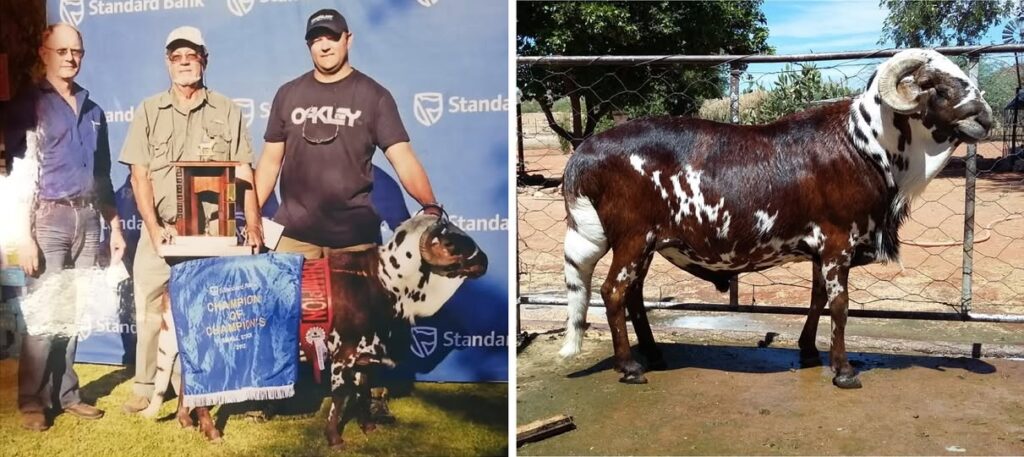
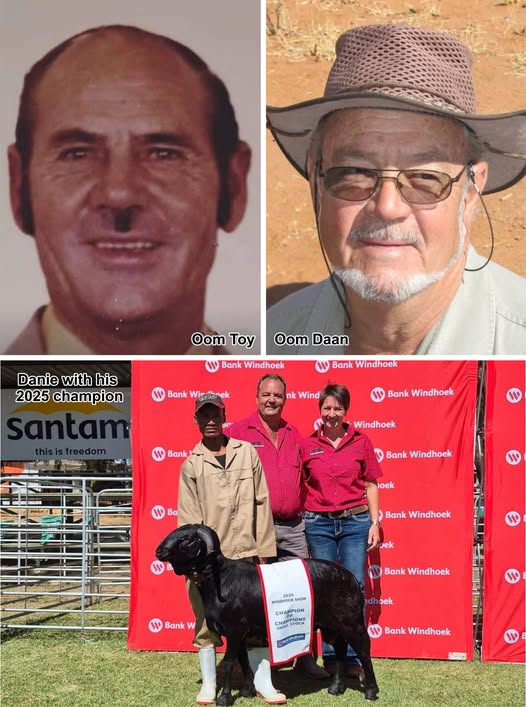
Daan’s ram, also named Weerlig, was crowned Champion of Champions at the Windhoek Show in 2013, and at one stage Daan held the world record price for a Damara ram. His son Danie was there for all of it, growing up around the flock his father had spent a lifetime building.
In later years, Danie joined him on the farm, and together they continued the work Maritz and Grové had begun — only now, through proper legal channels, bringing further purebred Kaokoland genetics south to strengthen the bloodline.
Daan Jansen van Vuuren died on the farm on a Monday morning in September 2019, hours after having to put down three of his cattle that hadn’t survived the drought — a hard morning, in an extremely hard year, for a man who never stopped working the land he was born on.
The bloodline didn’t end there. Danie bought his father’s sheep after his passing and breeds them still — the latest generation of the same family working the same genetics that Toy Maritz and Piet Grové first risked everything to bring south across the Red Line, more than seventy years ago. In 2025, that legacy came full circle: a ten-month-old ram lamb from Danie’s flock was crowned Champion of Champions at the Windhoek Show, the same title his father had won twelve years earlier with the champion Weerlig.
What this family achieved, across three generations, is genuinely rare in the history of any livestock breed. Maritz and Grové took the risk that put pure Kaokoveld genetics within reach in the first place, at a time when many farmers across the region were crossing their stock for quicker gains. Daan van Vuuren spent an entire working life turning that fragile inheritance into something permanent — official breed standards, a founding role in the national society, a world record ram, and a bloodline strong enough to still be winning championships six years after his death.
Maritz and Grové took the risk. Daan Van Vuuren carried it forward. Danie carries it still.
The Damara breed as a whole now grazes across at least four continents: Africa, where it began; Oceania, where it transformed Australian and New Zealand farming; Europe, where it’s now being trialled on Welsh hillsides; and North America, where it has proven it can handle snow as easily as it once handled desert as well as the rugged, mountainous and agricultural terrain of Mexico.
Today, Toy Maritz and Daan van Vuuren are rightly remembered as the founding fathers of the Damara.
Some things are worth risking everything for. This was one of them!